We will rise again, like the good Mary Ellen Carter

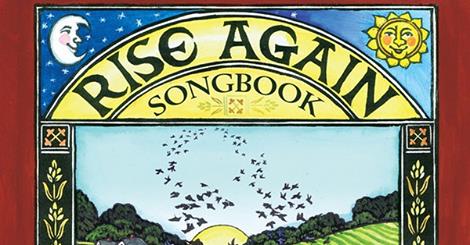
GUESTS: Peter Blood and Annie Patterson, creators of "Rise Up Singing" and their followup new songbook, "Rise Again," talk about the process and motivation behind this collection of words & chords to 1200 different songs, just published by Hal Leonard Performing Arts and Publishing Group.

Peter and Annie were great guests. Their enthusiasm for songs and communal singing is evident in just about every topic we covered. Rise Again was published to bring group singing to another generation. 

Pete Seeger often talked about the transformation that happens when people come together to make music. He believed that there was something magical in group singing:
All God's creatures got a place in the choir.
Some sing low and some sing higher,
Some sing out loud on a telephone wire,
Some just clap their hands, or paws, or anything they've got now.
I used to sing that song with my kids, and it was often quite moving to think of all living creatures finding common inspiration, be it in a choir or out loud on a telephone wire. Wonderful words for bringing our family closer together. We were all part of a grand musical plan.

I still play at open mics and music circles. Most of us are from the 1960's, but there are always some younger performers as well. Music brings us hope in an age of greed and militarism. Sharing hope makes us think that nothing is impossible, that we can create a just and loving society one day despite the odds.

We will rise again, like the good Mary Ellen Carter.

Easily waylaid by racism and fear

GUEST: Les Leopold, an economic researcher who co-founded The Labor Institute and The Public Health Institute, talks about his latest book: Runaway Inequality: An Activists Guide to Economic Justice.

Les Leopold is a story teller. What happened in the early 1980's that started giving all of society's wealth to the very rich? It is sort of a detective story, with the University of Chicago, and major corporation think tanks playing a role. Somehow, most economists embraced this new doctrine favorable to Wall Street, and the genie was out of the bottle. 

But why bother with understanding how the average wage earner has been screwed over the last few decades? Most Americans know that working people are now under the thumb of major corporations and Wall Street. Why not start the revolution now?

Eli and I had that discussion after the interview. I said that all liberation movements have to start with understanding and self knowledge. Unless people can see the totality of their oppression, they are easily waylaid by racism and fear. That is why we are seeing the return of fascist candidates now, eager to point the finger of blame in any direction but the wealthy elite. 

Eli had a good point too. Both of us had lived in occupy camps, although certainly not for very long. Wan't that a better way to see the emerging of a new world? Isn't it going to be a communal experience rather than a history lesson that really brings change!

Of course, self awareness groups are communal experiences, like our local reading of Michelle Alexander's The New Jim Crow. Les Leopold's last chapter is all about group learning, facilitators going out into the field to tell the story of Wall Street's takeover. 

The 99% has to be educated and organized to take on the neoliberal national security state. Organize a group and read Les Leopold's book for the new year!

Starting to take it apart

GUEST: James Kilgore, writer and social justice activist who spent six years in prison, talks about one of the books he was inspired to write while behind bars: Understanding Mass Incarceration: A People's Guide to the Key Civil Rights Struggle of Our Time.

James Kilgore presents the case in a way few people have done. I found his narrative very easy to understand, especially the connections he points out between a neoliberal economic system and incarceration of human beings for corporate profit. 

Mr. Kilgore is white, and I asked him if only white people were unaware of what our criminal "justice" system had become. He said that whites were the least informed, of course, because it was mostly not happening to them. Their schools were not in the poorest inner cities, and geared to criminalize student behavior. Their kids aren't stopped on the streets because of skin color. They could afford better lawyers and demand preferential treatment by white judges. Yes, the term "white privilege" is often a mystery to whites. Blacks have felt the pain of racism for centuries.

The movement is more than a wakeup call to whites, however. It is a chance for all of us to work together to undue systemic racism. Understanding Mass Incarceration shows us the nuts and bolts of oppression. It is up to an informed mass movement to start taking it apart. 


The Web of Interlocking Oppressions

GUEST: Barbara Smith, author, long time civil rights activist, and subject of the new book Ain’t Gonna Let Nobody Turn Me Around, talks about the Combahee River Collective and the interlocking oppressions of race, class, sexuality and gender in today's society.

Barbara Smith is very careful about words. The interview started with a discussion of the correct pronunciation of Combahee, not such an important matter in the long run. At some point, she asked to start the "official" interview recording, and we did. Why waste a few minutes on how to pronounce a word, especially since there is no consensus on the correct way? We started the interview again.

I used the above picture, not to represent the whole of Barbara Smith's emphasis, but because LGBTQ rights often get lost in discussions of women's and African American liberation. Barbara Smith explains that the fight for equality involves all groups that are debased by the majority culture, and that we can't achieve true freedom from discrimination unless we achieve freedom for all.

For Muslims too? For Palestinians? That is where Barbara Smith's radicalism comes out. She is soft spoken and articulate, but what she is saying challenges the establishment thinking about freedom. Is the US a land of opportunity for immigrant once they assimilate to American culture, or has our country always been a web of interlocking oppressions beginning with the genocide of indigenous peoples and continuing with the enslavement of millions of Blacks?

We live in an era that wants to separate antiSemitism from discrimination against Muslim Americans. Our country supports a brutal 65 year oppression of Palestinians by the apartheid state of Israel, yet our role in the Middle East is supposedly about bringing human rights to the people. The US also supports most of the brutal dictatorships in the region. Is this another example of interlocking oppressions? Can Blacks, women, and gays ever be free if they support the crushing of human rights abroad by the American Empire? Perhaps we have to rethink what racism is to include the interlocking exclusions upon which our society is built. The white males of Wall Street dictate the endless war against "terrorism" as a way to increase their obscene profits. Are they part of the interlocking oppression? Visionaries like Barbara Smith can show us the way.


Rooted in capitalist system ideology?

GUEST: Kaya Weidman, co-founder of Kite’s Nest, an organization that runs the Social Justice Leadership Academy's five week workshop for teenagers in Hudson, NY, talks about teaching community organizing and self expression to Black and Latino students through youth produced radio, music, poetry and public speaking.

This very interesting interview was done well over a month ago. I never thought that I would have a backload of excellent guests, but that is what has happened. We only interview one guest for each show. Perhaps we should expand this and cut back on Fantasy Land Media and our history section. Eli and I are going to review our mix in the coming weeks to see what needs to be changed.

One of the reasons we have so many thought provoking guests is that Gail Leondar-Wright, a book publicist, is sending me such great choices. And she sends me the books well before each show so that I can read them first. In fact, Activist Radio could rely completely on Gail and Just World Books for left oriented writers to interview. But that would leave out local connections to students and progressive community activists. 

Kaya is firmly in the community activist category. What she does in Hudson, NY, would go unnoticed without a local radio station like WVKR. Not completely unnoticed because there are other independent stations in the Mid Hudson area, and because Kaya is a good writer and gets articles published in progressive media. In fact, that is where I found Kaya. 

If you listened to our interview, we talk a lot about community organizing. Do whites have a role in teaching African Americans how to resist the oppression and racism that seems to be part of the fabric of our society? Back we go to Myles Horton and the Highlander Center, such an important part of the Civil Rights Movement. 

Myles considered himself an outsider who was thoroughly committed to overthrowing the status quo. He told us during a short visit I made to the Highlander Center that his type of activism came from an anti-authority streak rooted deeply in Southern consciousness. Early on, Myles had grown up outside the system, reading the Bible and Marx. He put a world view together for himself, free from miccle class influences. I feel that his teaching was equally free from white, middle class moralizing about how Blacks should better themselves. One of his books, We Make the Road by Walking, highlights this method of pedagogy. Myles was a traveler on the road, not a person with all the answers, and his rebellion extended all the way to how we learn in a capitalist society. Do we actually learn, or are we taught what to say and think? And can a person rooted in capitalist system ideology ever value human rights and economic justice for others? 


Time of commitment and joy

GUEST: Maria Luisa Rosal, field organizer for SOA Watch, and planner for the upcoming vigil on Nov 20 - 22 to close the School of the Americas at Fort Benning, Georgia, talks about the disastrous results of US military training being given to Latin American army personnel.

I remember first hearing former Roman Catholic priest Roy Bourgeois, founder of SOA Watch, at the St. Margaret's Episcopal Church in Staatsburg. He has a gift for educating people about the difficult subject of American militarism abroad. Most of his work has been done in Central and South America, a part of the world still suffering from US sponsored death squads and CIA funded coups against democratically elected presidents.

The subject is difficult for two reasons. We as American citizens rarely hear about what is being done to other countries in our name. Our media is closer to state sponsored propaganda than most of us realize, and since The New York Times doesn't cover imperialism in Latin America, we just don't know about it.

It is also difficult because once we learn the full extent of the suffering, we experience intense grief. Tens of thousands of women and children have been murdered by US supported dictators. Some of the worst butchery has been carried out using US supplied guns, ammunition and training. It is only after we have come to terms with this grief that we can organize to oppose US policy.

There is an exhilaration that comes from seeing that we can resist our country's racism and militarism in Latin America. Armed with a knowledge of US oppression, we can expose the long history of wars and military interventions based on US corporate profits.

November 20 - 22 is such a time of commitment and joy.

Behind Israel's war crimes


GUEST: Bassem Tamimi, internationally recognized Palestinian human rights activist from the West Bank farming village of Nabi Selah, talks about the weekly nonviolent demonstrations held in opposition to illegal Israeli settlement construction and military occupation.

I found it much harder watching  this YouTube video of this young Palestinian boy than talking to the young boy's father, Bassem.

Bassem Tamimi has a quite way about him, possibly from the beatings and torture he received in Israeli prisons for his activism. As he spoke to me, I became increasingly aware of what the Israelis will have to do to the Palestinians to permanently subjugate them or drive them away from their lands; Israel will have to massacre them. After over 65 years, the Palestinians are still resisting. Not only that, whole families like Bassem's have made keeping their lands and keeping their dignity their most important human value. 

Of course, in trying to ethnically cleanse the Palestinians from their homeland, the Israelis have lost their religion as well as their humanity. Occupation does that to the occupying nation. In the end, the occupier must become the murderer. 

Unexpectedly, Bassem talked about the Holocaust with sadness and sensitivity. Jews have suffered greatly, and now it is his people who bear the brunt of hatred and vicious racism. Did he feel a kinship with the Jews being persecuted in Germany during the 1930s? He certainly expressed his admiration for the Jewish Israelis who stand with him against the taking of his land and the murdering of his people. 

Like most human rights activists, Bassem has come to the conclusion that it is the apartheid state of Israel that is responsible for the impending genocide of his people. And behind it all stands the empire, always ready to provide Israel with weapons, billions in aid, and protection at the UN. Yes, behind Israel's war crimes are the American people, you and me.